This vivo dual monitor stand review looks at the VIVO STAND-V002LW, a freestanding mount for arranging two monitors vertically on a desk.
Its ultrawide support, adjustable brackets, and padded base suit users who want a stacked setup without attaching a clamp to the desk.
VIVO Dual Stand Review Summary
The quick verdict
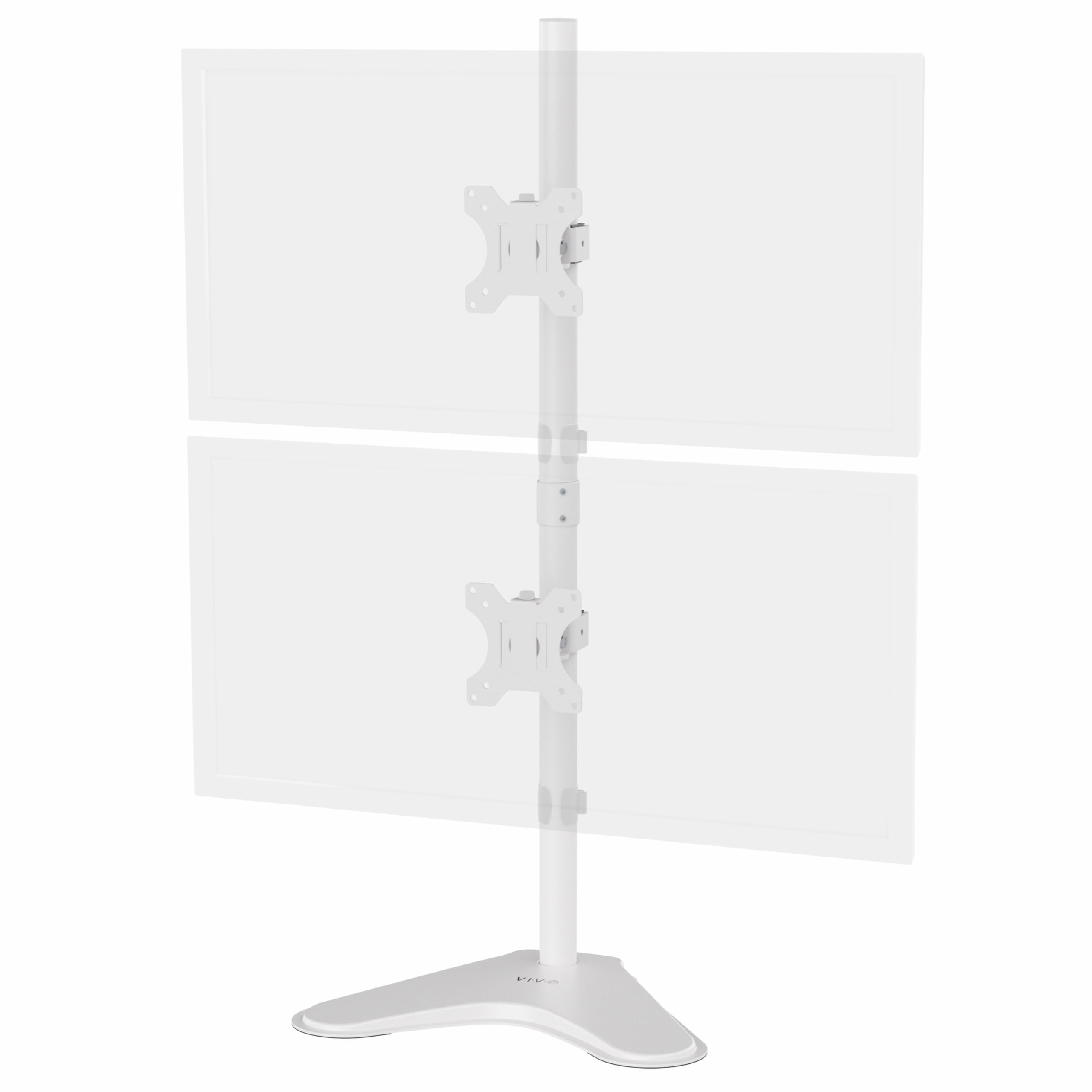
3,000+ ratings
Read Amazon ReviewsVIVO STAND-V002LW Dual Monitor Desk Stand
A fit for desk users stacking two standard or ultrawide monitors who want flexible positioning without clamping a mount to the desktop.
- Supports two monitors measuring 13 to 34 inches, with a maximum weight of 22 pounds per screen.
- Accepts monitors with 75×75 mm or 100×100 mm VESA mounting holes.
- The brackets tilt from +45 to −45 degrees, swivel 180 degrees, and rotate 360 degrees.
- Bracket height adjusts along the center pole; screens can be arranged in portrait or landscape orientation.

Pros
- Supports two ultrawide monitors up to 34 inches, within the stated weight and VESA limits.
- The freestanding design does not require a clamp or grommet hole in the desk.
Consider before buying
- The vertical stacked layout will not suit buyers who want two screens side by side.
- The base occupies a 15.4 × 12.4-inch area of the desktop, so measure the intended location and check that it will not crowd other items.
Read the full review summary
The STAND-V002LW is built around a clear purpose: hold two monitors in a vertical stack while allowing each screen to tilt, swivel, rotate, and move in height along the center pole.
It supports displays from 13 to 34 inches and up to 22 pounds each, provided they use a supported 75×75 mm or 100×100 mm VESA pattern.
The freestanding base also avoids the desk-edge requirements that come with clamp mounts.
This layout is a natural fit for work that benefits from a primary screen and a second display above it, such as reference material, chat, or monitoring windows.
It is less compelling if you prefer side-by-side monitors, need screens positioned far apart, or want an arm that can pull each screen forward independently.
Check the dimensions and weight of both monitors, their VESA holes, and the space available for the base before deciding.
The buying factors
VIVO Dual Stand Scorecard
Editorial scores reflect listed features and buyer fit; they are not laboratory measurements or customer ratings.
Screen compatibility
Supports two displays from 13 to 34 inches and up to 22 pounds each, with common 75×75 mm or 100×100 mm VESA patterns.
Positioning flexibility
Each bracket offers tilt, swivel, rotation, and height adjustment along the center pole for portrait or landscape placement.
Desk installation flexibility
The freestanding base avoids clamp installation, though it occupies a defined area on the desktop.
Workspace tidiness
Integrated cable management can help organize monitor cords, while the stacked arrangement keeps the displays in a compact footprint.
Setup convenience
Removable VESA plates and included hardware and instructions are intended to make mounting straightforward.
Large-screen suitability
The 34-inch maximum and 22-pound limit per display cover many ultrawide screens, but buyers still need to check each monitor's dimensions and mounting pattern.
Key Features and Specifications of VIVO Dual Stand
- Supports two monitors measuring 13 to 34 inches, with a maximum weight of 22 pounds per screen.
- Accepts monitors with 75×75 mm or 100×100 mm VESA mounting holes.
- The brackets tilt from +45 to −45 degrees, swivel 180 degrees, and rotate 360 degrees.
- Bracket height adjusts along the center pole; screens can be arranged in portrait or landscape orientation.
- A 15.4 × 12.4-inch freestanding base has padding on its underside to help protect the desk surface.
- Integrated cable management helps keep monitor cords organized.
- Removable VESA plates, assembly hardware, instructions, and a three-year warranty are included.
Pros and Cons of VIVO Dual Stand
Pros
- Supports two ultrawide monitors up to 34 inches, within the stated weight and VESA limits.
- The freestanding design does not require a clamp or grommet hole in the desk.
- Separate adjustable brackets allow each display to be tilted, swiveled, rotated, and set at a different height.
- The padded base is designed to protect the desktop from scratches.
Consider before buying
- The vertical stacked layout will not suit buyers who want two screens side by side.
- The base occupies a 15.4 × 12.4-inch area of the desktop, so measure the intended location and check that it will not crowd other items.
- Height adjustment is along the center pole, so this is not the same kind of reach-and-reposition setup as an independently extending arm.
Who Should Buy VIVO Dual Stand?
Good fit
Consider the STAND-V002LW if you want two screens stacked vertically and value a freestanding base.
That format can place a primary display below a second screen for reference material or other secondary tasks, while keeping both monitors on a single central support.
The adjustable brackets give you options to set tilt, swivel, rotation, height, and orientation to suit your arrangement.
Before ordering, check the weight of each monitor, its screen size, and the VESA pattern on the back.
Also account for the base footprint and the position of the upper screen relative to your normal viewing posture; the product details do not specify the total height range.
The removable plates and included assembly hardware should help simplify attachment, and the three-year warranty is a useful ownership detail.
Who should skip it
Skip this design if you need your displays arranged side by side or want to pull them independently toward the front or sides of the desk. A vertical center-pole stand is intended for a stacked arrangement.
Choose another setup if either monitor exceeds 34 inches or 22 pounds, or lacks the listed VESA mounting pattern. Confirm those compatibility details before buying.
How the VIVO Dual Stand fits a stacked monitor setup
A vertical layout with distinct uses
The central-pole arrangement is best suited to users who want one display above another.
It can keep a two-screen workflow in a compact area, but buyers should think through which tasks belong on the upper screen and how often they will need to look between displays.
Compatibility is more than diagonal size
The stated range reaches 34 inches and 22 pounds per monitor, but both limits matter alongside VESA compatibility. Check each screen separately, including whether the holes use a 75×75 mm or 100×100 mm pattern.
If a monitor is near the size limit, consider its overall width and how the two screens will sit when stacked.
A freestanding base has a desktop footprint
Because this stand rests on the desk, it avoids the need to attach a clamp or use a grommet opening.
In exchange, the 15.4 × 12.4-inch base takes up surface area; measure the available space and ensure the planned position leaves room for your other desk essentials.
Adjustability for fine-tuning the view
Tilt, swivel, and rotation provide several ways to orient the displays, including portrait placement, while height adjustment along the pole supports changes to the vertical spacing.
These are useful positioning controls, though the design centers both monitors on one support rather than offering independently extending arms.
Alternatives to VIVO Dual Stand
Computer Monitor Arms alternative
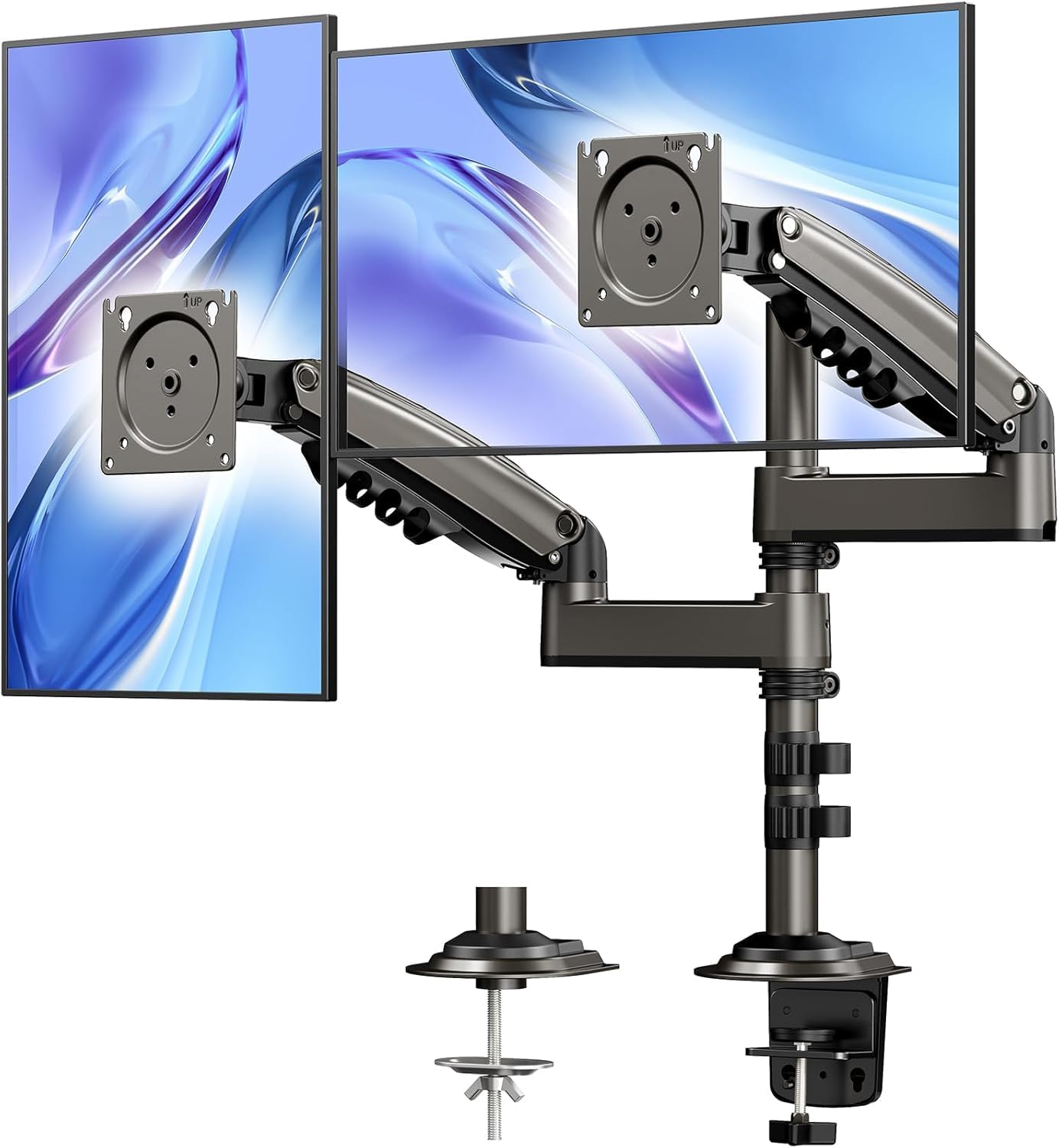
10,000+ ratings
Read Amazon ReviewsHUANUO Vertical Dual Monitor Stand
Choose the VIVO if your monitors approach its larger stated size or weight limits, or if a freestanding base suits your desk.
Consider the HUANUO if you prefer a clamp or grommet attachment and both monitors fit its lower limits and desk requirements.
- The HUANUO is also a vertical dual-monitor design.
- It supports screens up to 32 inches and 19.8 pounds each, with tilt, swivel, rotation, cable management, and either C-clamp or grommet mounting for specified desk thicknesses.
- The VIVO stand supports screens up to 34 inches and 22 pounds each, with a freestanding padded base and adjustable brackets for a vertical stack.
Computer Monitor Arms alternative
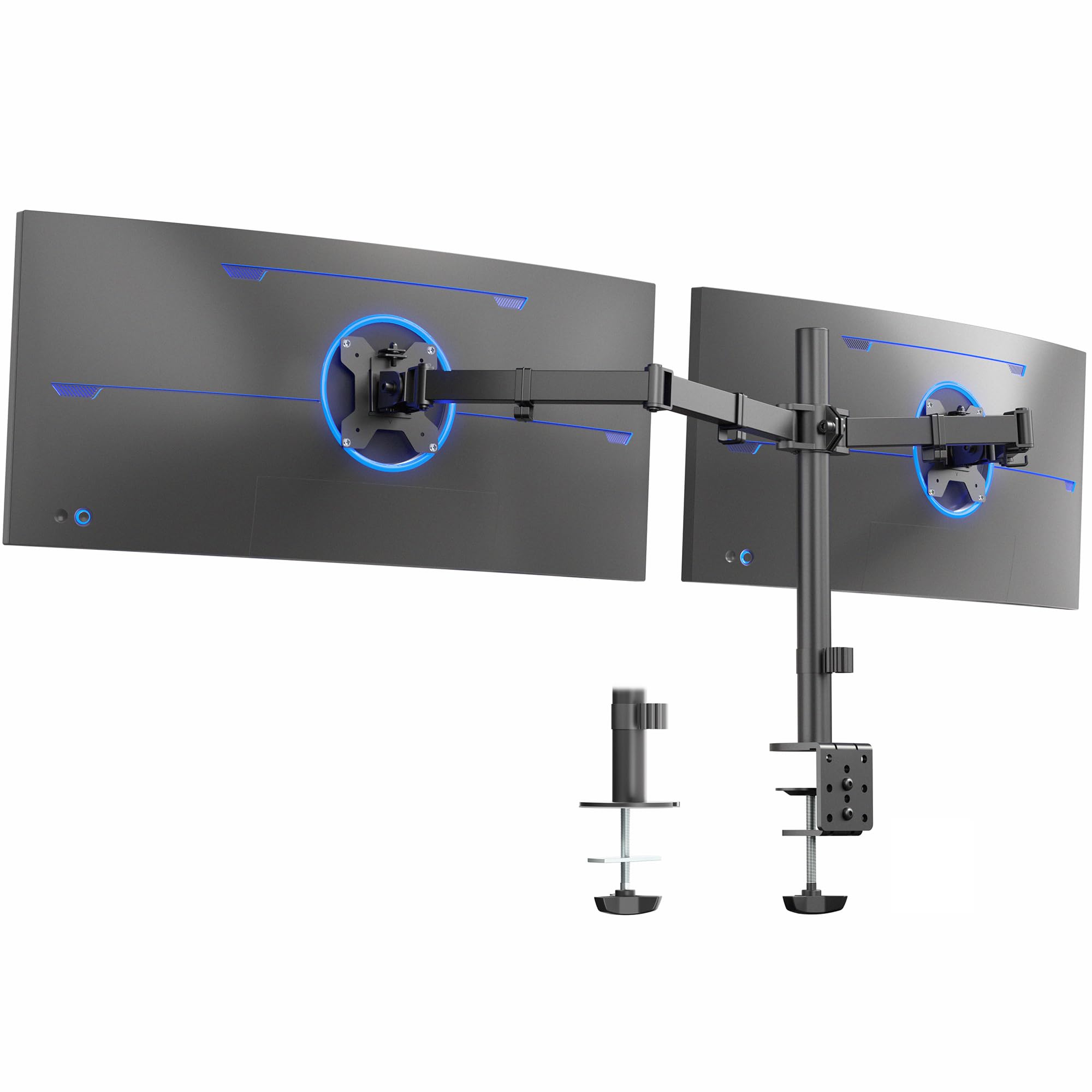
60,000+ ratings
Read Amazon ReviewsVIVO STAND-V038 Dual Ultrawide Desk Mount
Consider the STAND-V038 if your monitors exceed 34 inches but remain within its stated 38-inch limit and you can use its clamp or grommet mounting.
The STAND-V002LW is the better fit when you want a freestanding base and the stacked displays stay within 34 inches.
- The STAND-V038 supports two monitors up to 38 inches and 22 pounds each, with tilt, swivel, rotation, height adjustment, detachable VESA plates, and either C-clamp or grommet mounting.
- The STAND-V002LW uses a freestanding base and supports a vertical pair of monitors up to 34 inches and 22 pounds each.
Is VIVO Dual Stand Worth It?
The VIVO STAND-V002LW is worth considering if you want a freestanding vertical stand for two monitors, including ultrawides up to 34 inches, and both screens meet its weight and VESA limits.
Its adjustable brackets, cable management, padded base, and removable mounting plates support a practical stacked setup.
The key tradeoffs are the vertical-only arrangement and the desk space used by the base. Measure the footprint, check both monitors' compatibility, and make sure a stacked layout suits your work before choosing it.
Your review at a glance
3,000+ ratings
Read Amazon ReviewsVIVO STAND-V002LW Dual Monitor Desk Stand
A fit for desk users stacking two standard or ultrawide monitors who want flexible positioning without clamping a mount to the desktop.
- Supports two monitors measuring 13 to 34 inches, with a maximum weight of 22 pounds per screen.
- Accepts monitors with 75×75 mm or 100×100 mm VESA mounting holes.
- The brackets tilt from +45 to −45 degrees, swivel 180 degrees, and rotate 360 degrees.
- Bracket height adjusts along the center pole; screens can be arranged in portrait or landscape orientation.